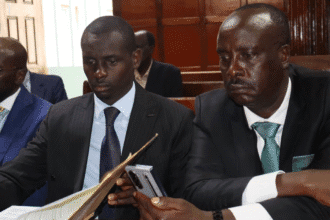



The High Court in Nairobi has partially granted an interim injunction sought by Supreme Court Judge Isaac Lenaola against businessman Kung’u Muigai. While stopping short of ordering the removal of existing online content, the court has barred Muigai from making any further defamatory statements against the judge pending the full determination of a lawsuit.
The ruling, delivered by Prof (Dr) Nixon Sifuna on 18th December 2025, stems from a defamation suit filed by Justice Lenaola. He accused Muigai of publishing and republishing allegations across multiple social media platforms and digital channels, including YouTube, TikTok, Facebook, X, and WhatsApp.
The allegation, which Muigai has admitted to making, is that Justice Lenaola, while serving as a High Court judge years ago, accepted a bribe of one million Kenyan shillings to deliver an adverse judgment in a case involving Muigai and a company he was associated with.
Justice Lenaola, in his application, contended that the widely disseminated statements were false and designed to destroy his reputation locally and internationally, thereby undermining public trust in the judiciary.
He presented evidence of a video interview posted on a TikTok account with nearly 20,000 followers, which garnered thousands of interactions. The plaintiff argued that Muigai had continued a “sustained onslaught” even after the suit was filed and a demand letter sent, showing no intention of desisting.
Muigai, in his defence, not only admitted to the publications but pleaded the defences of truth and fair comment. His lawyer, Senior Counsel Nelson Havi, argued against the injunction. “The Plaintiff is a corrupt judge who has no reputation to protect,” Mr Havi submitted, adding, “Hence that the Defendant was justified in accusing him of corruption.” The defence relied on legal authorities suggesting that interim injunctions should rarely be granted in defamation cases where such substantive defences have been raised.
Justice Sifuna acknowledged the heightened caution required when granting pre-trial injunctions in defamation matters, which sit at the crossroads of freedom of expression and the right to dignity. He referenced the established test from the case of Giella v. Casman Brown but noted that Kenyan jurisprudence requires an additional layer.
“In defamation suits, interlocutory pre-trial injunctions may be issued where the Application has satisfied the legal threshold in Giella, as well as the requisite supplemental threshold of additionally also demonstrating that there exist exceptional factors or circumstances,” the judge outlined.
The court found such exceptional circumstances present. It noted the repetitive and persistent nature of Muigai’s utterances, which continued unabated after the lawsuit began, creating a reasonable fear of further publication. “The Defendant has continued making those utterances despite the pendency of the suit, and he is unlikely to cease or desist, because he believes they are true and justified. He is unlikely to stop, unless restrained by a court order,” the ruling stated. This pattern satisfied the court that a prohibitive injunction was “most compelling and most inviting.”
However, the judge declined to issue the more drastic mandatory injunction sought by Justice Lenaola, which would have compelled Muigai to delete, retract, and pull down all existing defamatory material from the internet. Justice Sifuna held that the legal threshold for a mandatory order was even higher, typically reserved for cases where a defendant has no defence.
With Muigai having raised defences of truth and fair comment, which are complete defences if proven, forcing removal now could prejudice him should he ultimately succeed at trial. “Such a drastic action, may result in prejudice to the Defendant, for instance if the court later in its judgment, finds that there was no defamation,” the judge reasoned.
The court refused to pre-judge the central issue of whether Justice Lenaola’s reputation was irredeemably damaged, as alleged by the defence. Dismissing the defence’s characterisation of the plaintiff as having no protectable reputation as “premature,” Justice Sifuna affirmed a foundational legal principle. “Afterall, everyone is presumed to have a good reputation, until proved otherwise. Which is a rebuttable presumption, to be rebutted by the adduction of evidence at trial,” he stated.