





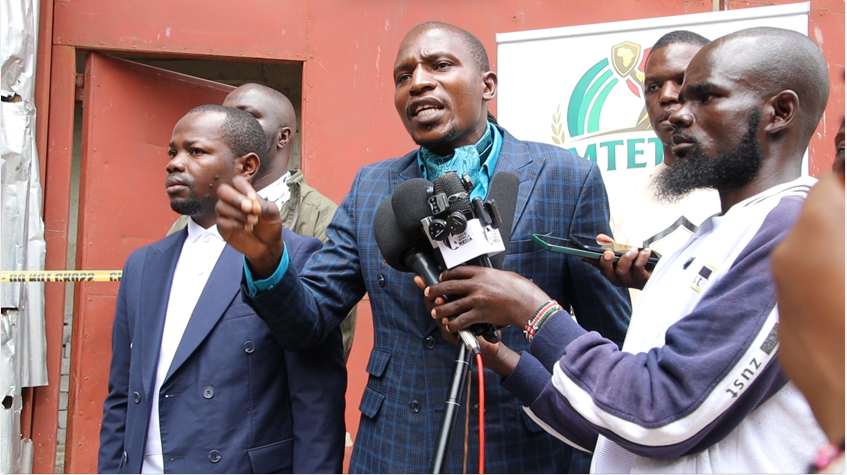
NAIROBI, Kenya— Mtetezi, a grassroots economic justice movement, has released a press statement calling for urgent accountability from county and national authorities following a series of building collapses across Nairobi.
The movement described the crisis as a failure of the government rather than a string of unfortunate accidents. The statement was issued by Francis Awino, the chairperson of Mtetezi, days after the partial collapse of a 22-storey building that was under construction in Westlands.
The collapse left multiple workers trapped and at least one dead. The incident happened days after a similar collapse happened in Shauri Moyo on March 16 which killed four people. Other tragedies of similar nature also happened earlier in South C and Karen with them claiming the lives of two workers.
“Buildings do not collapse only because concrete is weak,” Mtetezi said in its statement. “Buildings collapse because institutions are weak.”
The movement highlighted five systemic failures which it alleged led to the crisis:
Manipulation of site conditions and planning information to justify developments that should never have been approved in the form they take.
Irregular and unlawful approvals, including cases where proper technical scrutiny appears incomplete or compromised.
Gross zoning non-compliance and unlawful densification that puts too much pressure on land, infrastructure and safety systems.
Violations of setback, ventilation, privacy and public health requirements, which are not cosmetic rules but part of the safety architecture of an urban area.
Enforcement failure: notices are issued, red flags are raised, but works continue..
“A stop order that does not stop anything is not enforcement,” the statement read. “A revocation that does not halt construction is not accountability.”
Mtetezi directed its demands at several offices and institutions:
Nairobi County Governor Johnston Sakaja must publicly disclose the approval, inspection and enforcement history for all recent collapse sites.
County planning and development control departments must reveal which high-risk buildings in the city are currently under dispute, notice or investigation.
The National Construction Authority, the Engineers Board of Kenya and the Board of Registration of Architects and Quantity Surveyors must identify the professionals associated with the collapses and confirm whether disciplinary proceedings have commenced.
The Ministry responsible for housing and public works, as well as Parliament, the Senate and the Nairobi County Assembly, should treat this as a national urban safety crisis and convene urgent public hearings on illegal approvals and enforcement failures.
The Directorate of Criminal Investigations (DCI), the Director of Public Prosecutions (DPP) and the Ethics and Anti-Corruption Commission (EACC) must investigate any collusion, corruption or manipulation of records connected to unsafe developments.
The movement argued that ignored inspection reports and shelved investigations effectively functioned as silent permits for future disasters.
“Every ignored report is a future death notice,” Mtetezi stated. “Every filed-and-forgotten investigation is a silent permit for the next disaster.”
In its statement Mtetezi expressed solidarity with construction workers and residents living in the shadow of structurally questionable buildings.
The movement closed its statement with a firm demand: “No more collapsing buildings. No more buried reports. No more buried victims.”


