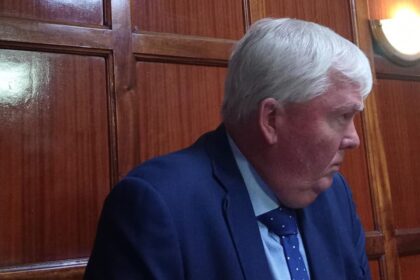


Geoffrey Kaaria Kinoti and seven others have moved to the Milimani High Court, contesting criminal proceedings brought against them in what they argue is an unlawful and unconstitutional prosecution. The case, filed as Constitutional Petition No. E495 of 2021, arises from charges linked to alleged tax-related offences involving Africa Spirits Limited and Wow Beverages Limited.
The petitioners are facing multiple counts, including possession of excise stamps acquired without authority, handling goods affixed with counterfeit stamps, and engaging in tax fraud. Court documents indicate that authorities allege the accused were found with hundreds of reels of unauthorised excise stamps and over one million bottles of alcoholic beverages bearing counterfeit markings.
They are also accused of failing to remit taxes amounting to billions of shillings over several financial periods, with the figure cited in the charges exceeding Ksh17.7 billion.
In their petition, the group argues that the prosecution is fundamentally flawed, pointing out that the charge sheet was drawn and signed by police officers instead of the Director of Public Prosecutions (DPP). They contend that this contravenes constitutional requirements, maintaining that criminal proceedings must originate from the DPP.
They further challenge the role of the Directorate of Criminal Investigations (DCI), arguing that the agency acted beyond its mandate by investigating tax-related matters. According to the petitioners, the enforcement and administration of tax laws fall under the Kenya Revenue Authority (KRA) and any investigations should be conducted under its authority or supervision.
The petition also raises concerns over alleged violations of constitutional rights, including the right to a fair trial. The applicants claim that evidence used against them was obtained unlawfully and that some material that could support their defence was removed or destroyed during investigations, undermining their ability to present a proper case.
Additionally, they question the independence of the prosecution, arguing that individuals associated with the complainant institution were appointed to prosecute the case, creating a conflict of interest.
The petitioners further point to an ongoing dispute before the Tax Appeals Tribunal, arguing that the criminal case overlaps with tax proceedings and amounts to an abuse of the legal process. They claim the tax assessment under dispute is significantly lower than the figures cited in the criminal charges, raising questions about consistency and intent.
In response, state agencies including the DPP, DCI and KRA have defended the prosecution, maintaining that the investigations were conducted lawfully and within their respective mandates. They argue that tax offences fall under economic crimes, which the DCI is empowered to investigate, and that criminal proceedings can proceed alongside tax disputes.
The High Court is now expected to determine whether the prosecution meets constitutional standards, including whether investigative and prosecutorial roles were properly exercised and whether the petitioners’ rights were violated in the process.